

One of the biggest differences between sports in Europe and the United States has nothing to do with the rules of the game.
It’s the structure of the leagues themselves.
In much of Europe, teams that finish at the bottom of the standings are relegated to a lower division, while top-performing teams from lower leagues are promoted.
In the United States, major leagues such as the National Football League, Major League Baseball, National Basketball Association, and Major League Soccer operate as closed leagues, where teams remain in the league regardless of their performance.
Both systems have passionate supporters.
So which one is better?
The answer depends on what fans value most.
How Promotion and Relegation Works
In many European soccer leagues, the lowest-ranked teams at the end of the season are relegated to a lower division.
At the same time, the best teams from the lower division earn promotion to the top league.
This system creates a constantly changing landscape.
A small club can rise through the ranks and eventually compete against the biggest teams in the country.
At the same time, even historic clubs can be relegated if they perform poorly.
The Advantages of Promotion and Relegation
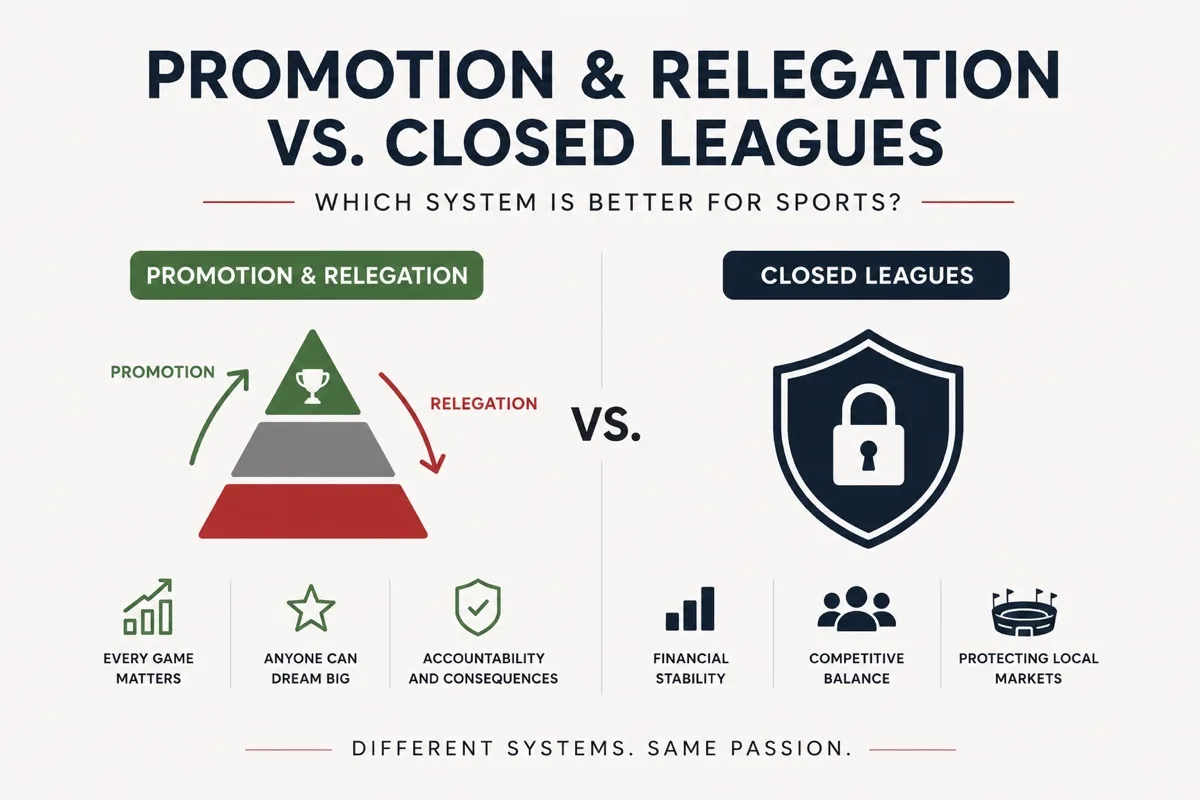
Every Game Matters
One of the biggest benefits of promotion and relegation is that teams rarely have meaningless games.
Even clubs near the bottom of the standings are fighting to avoid relegation.
That creates drama throughout the season and keeps fans engaged.
Smaller Clubs Can Dream Big
Promotion gives smaller clubs something to strive for.
A team from a small town can theoretically climb through the divisions and reach the highest level of competition.
For many fans, this is one of the most exciting aspects of European sports.
Accountability
Teams cannot simply have bad seasons year after year without consequences.
Poor management, bad decisions, and weak performances can lead to relegation.
Supporters often view this as a fair system that rewards success and punishes failure.
The Disadvantages of Promotion and Relegation
Financial Instability
Relegation can be devastating financially.
Teams may lose television revenue, sponsorships, and attendance almost overnight.
In some cases, relegation can impact a club for years.
Difficult Long-Term Planning
Because the risk of relegation always exists, some clubs may hesitate to invest heavily in facilities, players, or long-term projects.
The uncertainty can make financial planning difficult.
Larger Gaps Between Rich and Poor Teams
While promotion creates opportunities, many critics argue that wealthier clubs still dominate because they have larger budgets and resources.
Why American Sports Use Closed Leagues
American sports developed differently.
Instead of promotion and relegation, leagues operate as permanent franchises.
Teams remain in the league regardless of their record.
Expansion occurs only when the league chooses to add new franchises.
This system has been used successfully for decades across major American sports.
The Advantages of Closed Leagues
Financial Stability
Owners know their teams will remain in the league regardless of one bad season.
This stability encourages investment in stadiums, facilities, and long-term development.
Competitive Balance
Many American leagues use salary caps, drafts, and revenue-sharing systems to help create parity.
In theory, weaker teams have opportunities to improve and become competitive.
Protecting Local Markets
Fans don’t have to worry about losing top-level sports because of relegation.
Whether a team finishes first or last, it remains part of the league.
The Disadvantages of Closed Leagues
No Relegation Pressure
Critics argue that some teams can remain uncompetitive for years without facing major consequences.
A poor season may result in a high draft pick rather than relegation.
Limited Opportunities for Smaller Markets
Unlike Europe, smaller clubs cannot earn their way into the top league through on-field success.
Entry into major American leagues usually requires ownership approval and significant financial investment.
Fewer High-Stakes Games Near the Bottom
While playoff races create excitement, teams at the bottom of the standings often have little to play for late in the season.
Which System Is Better?
There is no perfect answer.
Supporters of promotion and relegation love the drama, opportunity, and accountability it creates.
Supporters of American-style leagues appreciate the financial stability, competitive balance, and long-term growth opportunities.
Both systems have produced passionate fan bases, legendary teams, and unforgettable moments.
Perhaps the real lesson is that great sports can thrive under different structures.
Whether you’re watching soccer in Europe or baseball, football, basketball, and soccer in the United States, one thing remains the same:
Fans simply want meaningful competition, memorable moments, and teams they can proudly support.
Final Thoughts
The debate between promotion and relegation versus closed leagues will likely continue for years.
Neither system is perfect.
Both have strengths and weaknesses.
But understanding these differences helps explain why sports culture feels so different on each side of the Atlantic—and why fans continue to passionately defend the system they know best.